Fifty Years of the Nautilus: Patek Philippe Opens a Museum Exhibition Dedicated to an Icon
A steel sports watch that defied every convention of its era turns fifty, and Patek Philippe is marking the moment with a museum retrospective in Geneva and the four limited edition references that prove the original idea has lost none of its force.

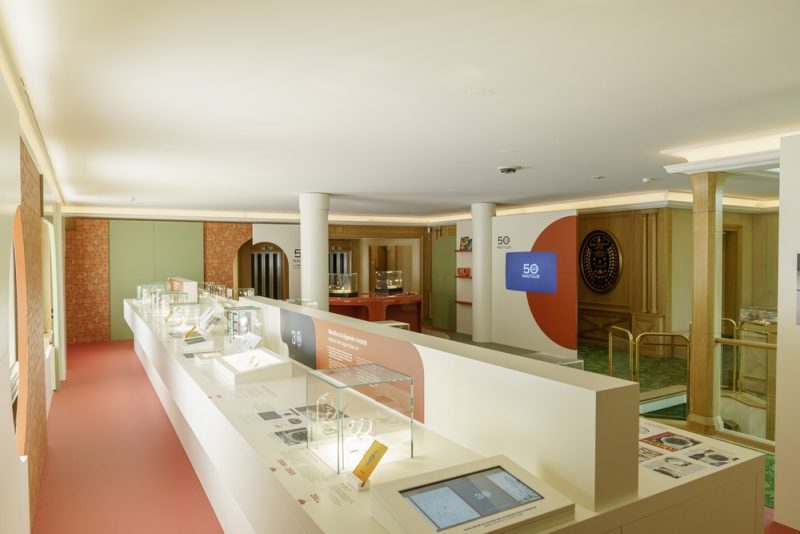
The Patek Philippe Museum in Geneva has announced a thematic exhibition retracing fifty years of the Nautilus collection, launching this month and running through early 2027. The exhibition opened during the Museum’s Open House Weekend on June 6 and 7, 2026, and draws on the historical archives of the Manufacture alongside a curated selection of Nautilus references that chart each distinct period of the collection’s life. It is a rare opportunity to trace the full arc of what began in 1976 as a genuinely disruptive idea and became one of the defining icons of modern Swiss watchmaking.
Visitors to the exhibition will also have the chance to see the four limited edition references that Patek Philippe unveiled at Watches and Wonders Geneva in April 2026 to mark the anniversary, each one a study in what the original design vocabulary looks like when stripped back to its essentials.
The Watch That Should Not Have Worked
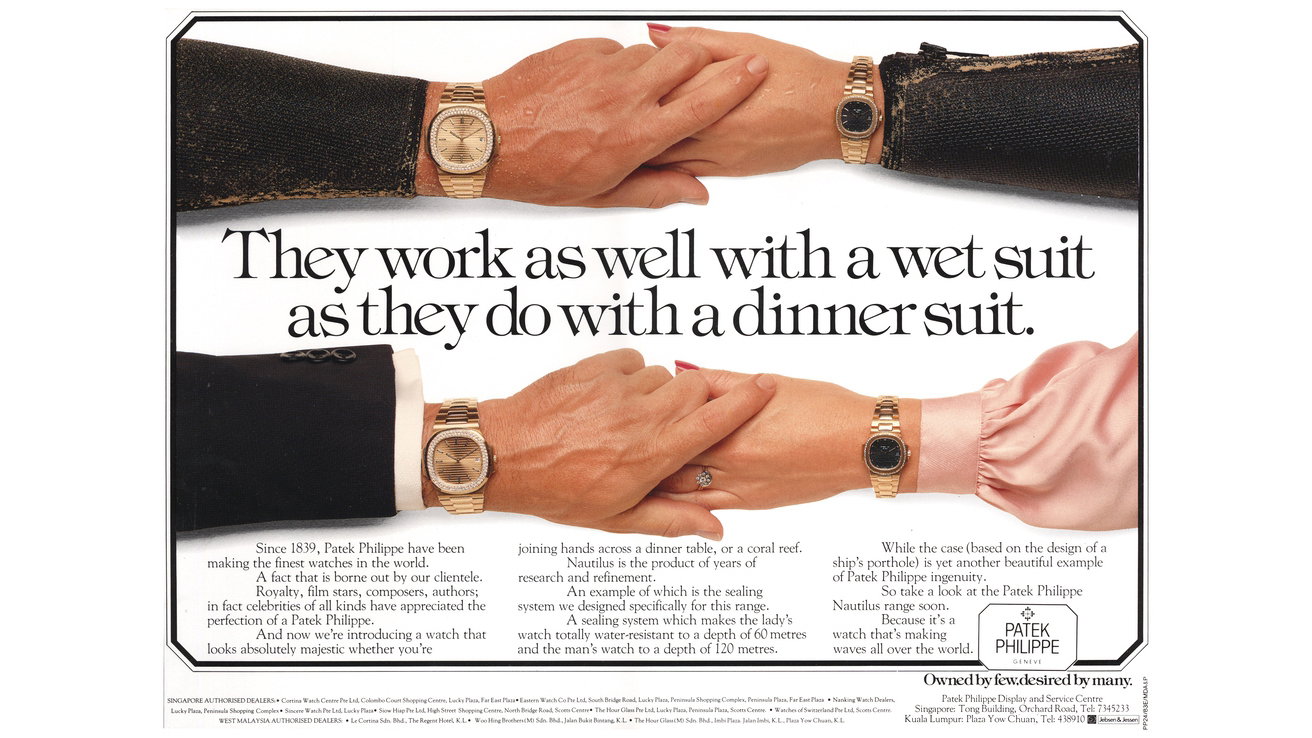
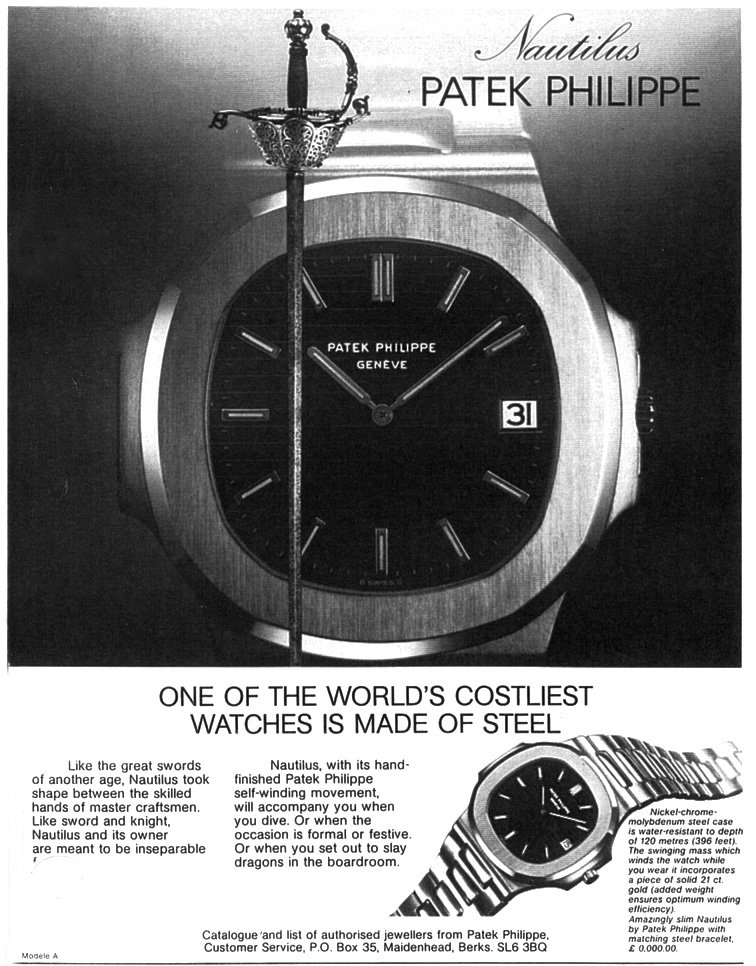
To understand why the anniversary matters, it helps to remember what the Nautilus actually represented when Gerald Genta delivered his sketch on a paper napkin in 1976. Patek Philippe was not a company that made steel sports watches. No one at that level of the market did. Steel was a material for tool watches and entry-level timepieces, not for a house whose reputation rested on complications in precious metal. The Nautilus arrived as a direct challenge to that assumption, and it arrived with a price tag, at launch, that was higher than many gold watches from comparable makers.
The case design was equally unconventional. The octagonal bezel with softened corners was not an design exercise. It was an engineering solution, drawn directly from the functional logic of a ship’s porthole. A porthole achieves its watertight seal through a hinge-and-bolt clamping system that pulls the frame tight against the hull, and Genta applied exactly that logic to the Nautilus case. The two-part construction in which the case back and middle section is drilled in a single location, for the winding stem, and the bezel is secured against the case by four clamping screws, is functional architecture wearing the clothes of design. Every detail that looks decorative is doing structural work.
The result was a watch that was water resistant to a degree that was genuinely unusual for a piece of its slenderness and elegance, a technical achievement that only becomes more impressive when you consider how thin the profile actually is. The horizontal relief embossing on the dial, the alternating polished and satin-brushed surfaces on the case and bracelet, the bracelet integrated so seamlessly into the case that it reads as a single continuous form. The Nautilus did not look like a sports watch that had been dressed up. It looked like something that had been conceived as a single unified object from the beginning, because it had.
Four Limited Editions for the Fiftieth
The anniversary releases, which made their public debut at Watches and Wonders Geneva 2026 in April, consist of four references. Three are wristwatches, each powered by the caliber 240. One is something altogether more unexpected.
References 5810/1G-001 and 5810G-001: The 41mm White Gold Pair
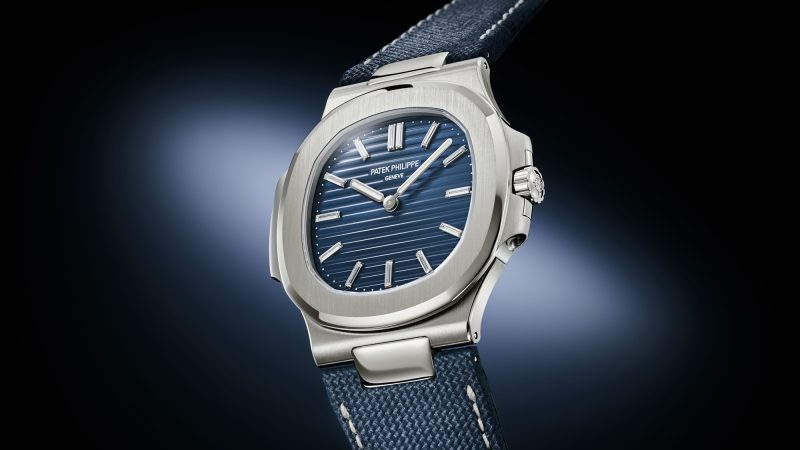
The two largest anniversary references share a 41mm case in white gold with a profile measuring 6.9mm. That combination of diameter and thickness is the clearest possible statement of intent. Both watches display only the hours and minutes, a deliberate return to the spare elegance of the original Reference 3700. When there is nothing on the dial but a sunburst finish, horizontal relief embossing, applied baton hour markers, and rounded baton hands in white gold with white luminescent coating, the design has to carry the entire weight of the object. It does.
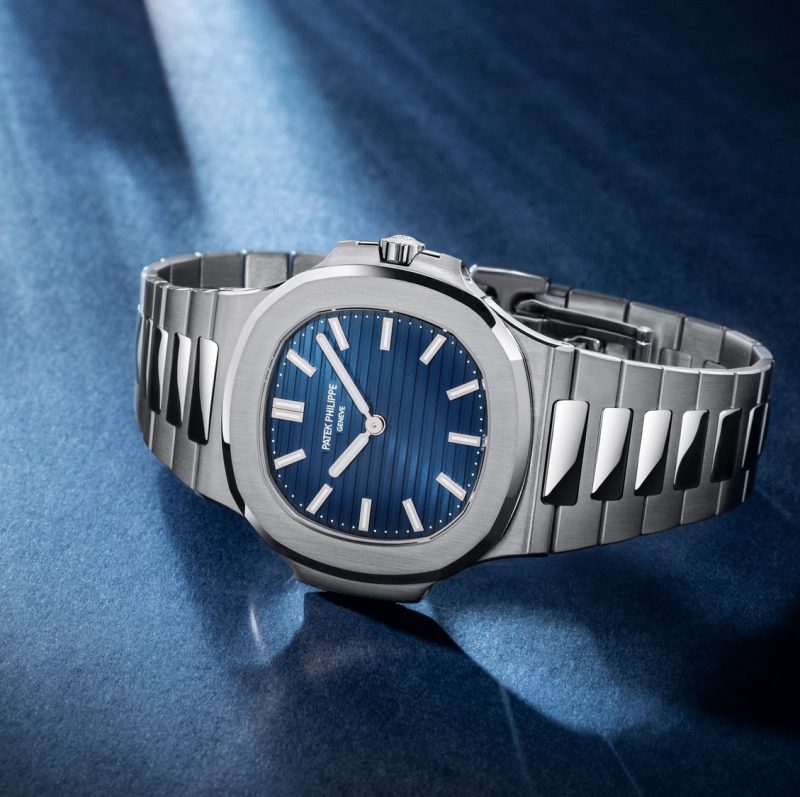
The differences between the two references come down to bracelet and dial treatment. Reference 5810/1G-001, limited to 2,000 pieces, is worn on an integrated white gold bracelet secured by a Patek Philippe fold-over clasp with a lockable adjustment system. Reference 5810G-001, limited to 1,000 pieces, comes on a composite strap with a navy-blue and cream fabric motif and a Nautilus fold-over clasp in white gold, and its dial adds applied hour markers set with baguette-cut diamonds.
At the heart of both is the caliber 240, the ultra-thin self-winding movement that Patek Philippe first introduced in 1977, a year after the Nautilus launched. It measures 2.53mm in height. Its 22K gold mini rotor is engraved with the inscription “50 1976-2026.” The movement is visible through a sapphire crystal. That both the collection and its defining caliber arrived within twelve months of each other is not a coincidence; they were conceived as companions, and after fifty years they still are.
Reference 5610/1P-001: 38mm in Platinum
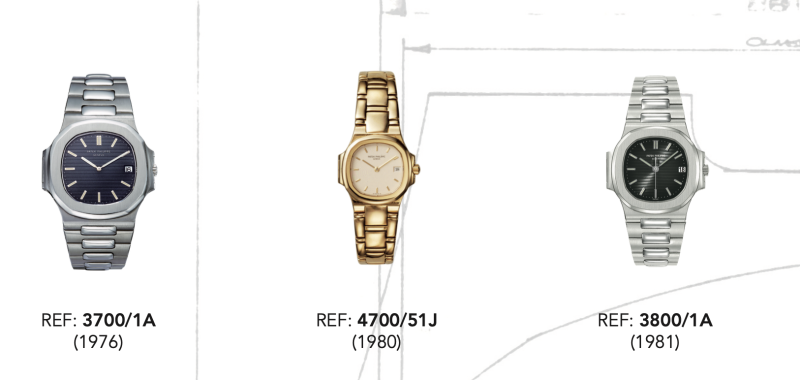
The third wristwatch anniversary reference steps down in size and up in material. At 38mm in platinum with the same 6.90mm profile, Reference 5610/1P-001 draws a direct line back to the medium-size Nautilus introduced in the 1980s as Reference 3800/1 and revisited in 2006 for the 30th anniversary as Reference 5800/1A. The return of the medium case at this moment is a considered decision, a reminder that the Nautilus was never solely defined by the Jumbo.
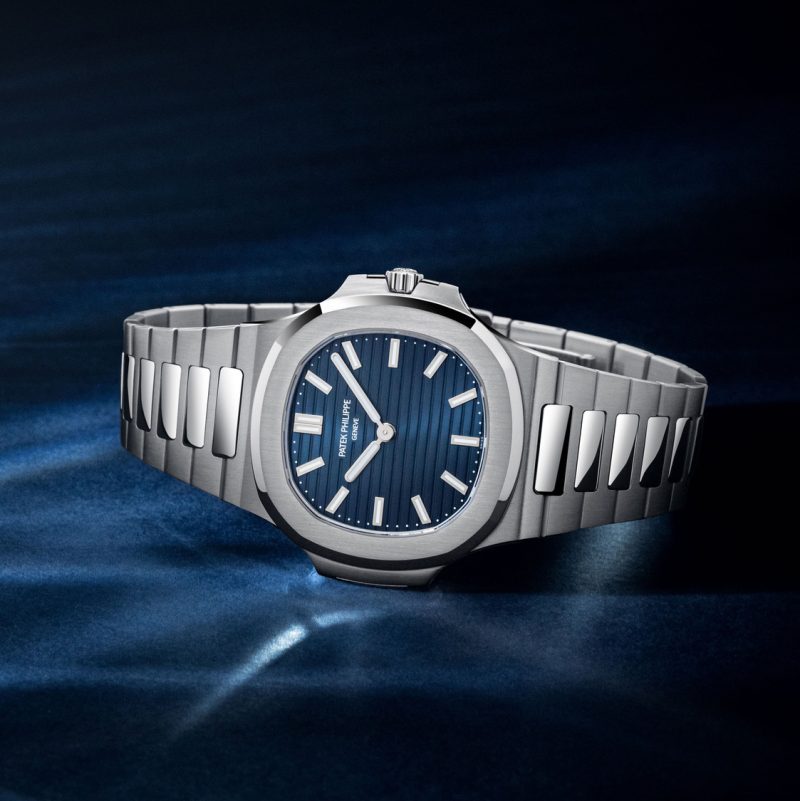
The platinum case introduces a detail that appears on all Patek Philippe platinum models: a diamond. Here it is set into the hinge at nine o’clock, a placement that the brand describes as a first for this location on the Nautilus. The dial is the same blue sunburst with horizontal relief embossing seen on the white gold references, with white gold applied markers and rounded baton hands in white gold with luminescent coating. The caliber 240 is present here as well, with the same engraved mini rotor. The integrated platinum bracelet, with its alternating satin-brushed and polished surfaces, is secured by the fold-over clasp with lockable adjustment. This reference is also limited to 2,000 pieces.
Reference 958G-001: The Desk Watch
The fourth anniversary reference is the one that no one expected. Reference 958G-001 takes the Nautilus silhouette off the wrist entirely and translates it into a desk watch, the first time the design has appeared in this form. The white gold case measures 50.65mm across its ten-to-four diameter, and every element of the Nautilus vocabulary is intact: the octagonal bezel with rounded corners, the two-part porthole construction, the contrasting polished and satin-brushed surfaces. The blue sunburst dial carries horizontal relief embossing and applied white gold hour markers set with baguette-cut diamonds totaling 0.96 carats.
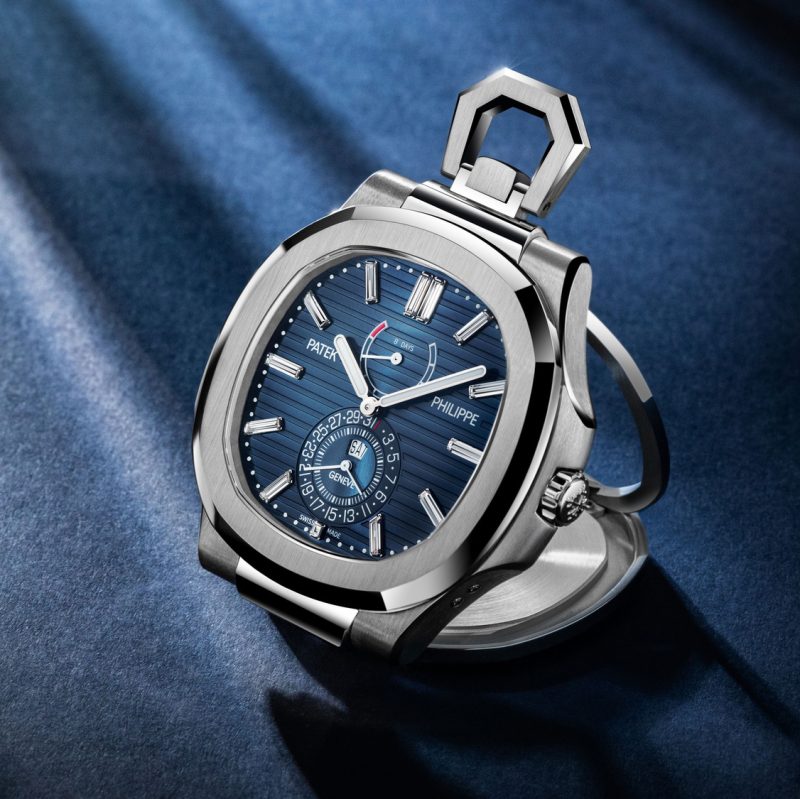
Inside beats the manually wound caliber 31-505 8J PS IRM CI J, first introduced in 2025 in the Calatrava 8-Day Reference 5328G-001. Its two going barrels in series deliver eight full days of power reserve, with a ninth in hand, and the display adds an instantaneous date, instantaneous day, small seconds at six o’clock, and a power reserve indicator. The Pulsomax escapement and Spiromax balance spring are both in Silinvar. On the back, a hinged cover decorated with a blue sunburst and an applied Calatrava cross conceals an engraved inscription reading “50th Anniversary Nautilus 1976-2026 Patek Philippe,” while the hinge system doubles as the stand. Reference 958G-001 is limited to 100 pieces.
Presentation and Water Resistance
All four anniversary watches are delivered in a presentation case with a cork exterior, a reference to the original Reference 3700 packaging from 1976 and to the cork cases used for the 40th anniversary editions in 2016.
In line with the unified water resistance standard that Patek Philippe formalized in 2024, the three wristwatches are rated to 30 meters, tested in both air and underwater at an overpressure of three bars. The desk watch, Reference 958G-001, is protected against humidity and dust only.
The Patek Philippe Nautilus Exhibition
The thematic exhibition at the Patek Philippe Museum in Geneva provides the historical context for all of it. Drawing on the Manufacture’s archives and a selection of Nautilus references that defined each era of the collection, it traces the full story from the watch that arrived in 1976 as something no one had asked for and that the market initially viewed with considerable skepticism, to the piece it became: a watch that redefined what luxury could look like, that proved steel was not a compromise, and that demonstrated an octagonal case could carry more elegance than most round ones ever would. The exhibition runs through early 2027.
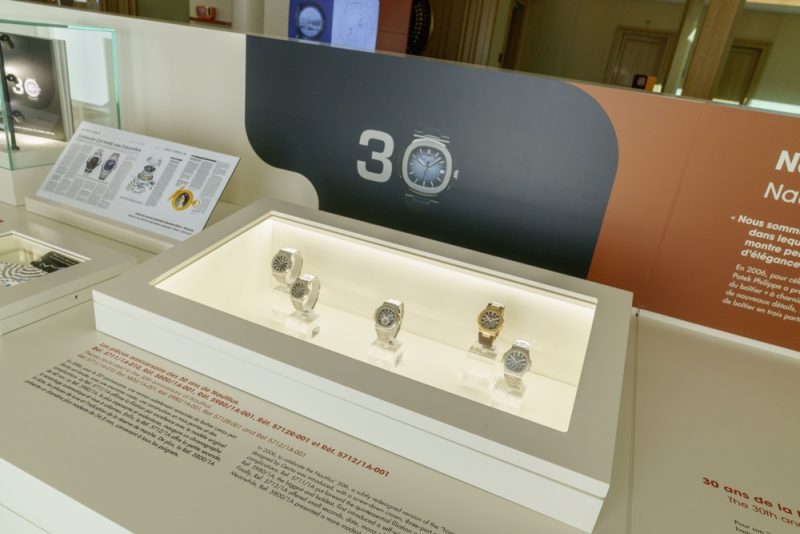
For anyone who wants to understand why the Nautilus still commands the attention it does, fifty years after a designer sketched it on a napkin in a restaurant, the answer is in Geneva. The exhibition runs through early 2027 at the Patek Philippe Museum.